12 Factory Method Pattern
12.1 What is Factory Method?
Factory Method is a creational design pattern that provides an interface for creating objects in a superclass, but allows subclasses to alter the type of objects that will be created.
The key idea: “Define an interface for creating an object, but let subclasses decide which class to instantiate.”
12.2 Structure (from your diagram)
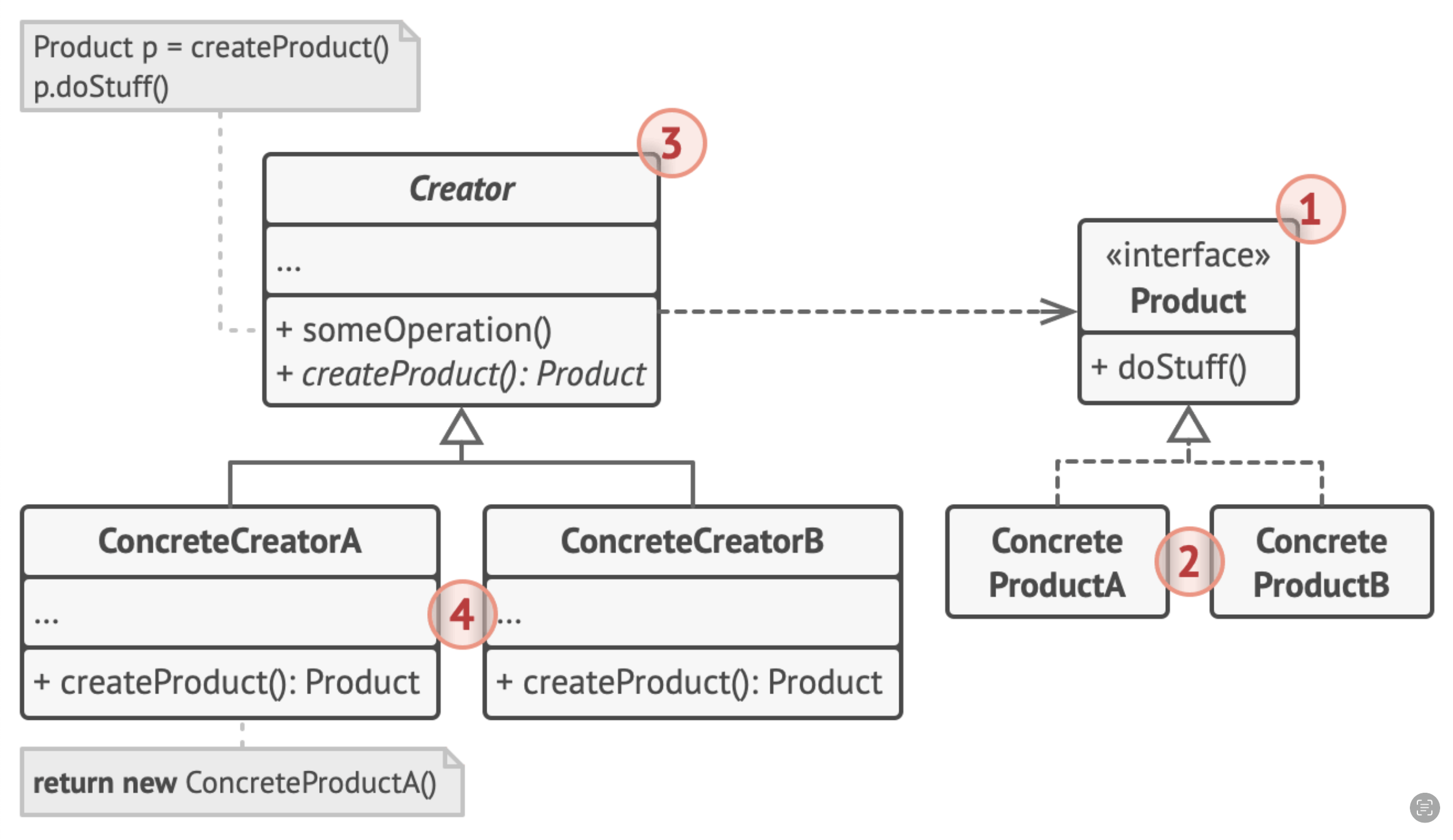
Legend:
- ➊ Product Interface - defines what products can do
- ➋ Concrete Products - actual implementations
- ➌ Creator - declares factory method (abstract)
- ➍ Concrete Creators - implement factory method, decide WHICH product to create
12.3 Python Example: Medical Image Exporter
Here’s a practical example relevant to radiology—exporting medical images in different formats:
from abc import ABC, abstractmethod


# ═══════════════════════════════════════════════════════════════
# PRODUCT INTERFACE ➊
# ═══════════════════════════════════════════════════════════════

class ImageExporter(ABC):
    """Abstract Product: defines interface for all exporters."""

    @abstractmethod
    def export(self, image_data: bytes, filename: str) -> str:
        """Export image data to a file."""
        pass

    @abstractmethod
    def get_extension(self) -> str:
        """Return file extension for this format."""
        pass


# ═══════════════════════════════════════════════════════════════
# CONCRETE PRODUCTS ➋
# ═══════════════════════════════════════════════════════════════

class DicomExporter(ImageExporter):
    """Concrete Product: exports to DICOM format."""

    def export(self, image_data: bytes, filename: str) -> str:
        filepath = f"{filename}.{self.get_extension()}"
        print(f"Exporting DICOM with metadata tags to: {filepath}")
        # Actual DICOM writing logic here...
        return filepath

    def get_extension(self) -> str:
        return "dcm"


class NiftiExporter(ImageExporter):
    """Concrete Product: exports to NIfTI format."""

    def export(self, image_data: bytes, filename: str) -> str:
        filepath = f"{filename}.{self.get_extension()}"
        print(f"Exporting NIfTI with affine matrix to: {filepath}")
        # Actual NIfTI writing logic here...
        return filepath

    def get_extension(self) -> str:
        return "nii.gz"


class PngExporter(ImageExporter):
    """Concrete Product: exports to PNG format."""

    def export(self, image_data: bytes, filename: str) -> str:
        filepath = f"{filename}.{self.get_extension()}"
        print(f"Exporting PNG (8-bit, window/level applied) to: {filepath}")
        # Actual PNG writing logic here...
        return filepath

    def get_extension(self) -> str:
        return "png"


# ═══════════════════════════════════════════════════════════════
# CREATOR (ABSTRACT) ➌
# ═══════════════════════════════════════════════════════════════

class ImageProcessor(ABC):
    """
    Abstract Creator: declares the factory method.

    Note: Creator's primary responsibility is NOT creating products.
    It contains core business logic that USES products.
    """

    @abstractmethod
    def create_exporter(self) -> ImageExporter:
        """
        Factory Method: subclasses decide which exporter to create.
        """
        pass

    def process_and_export(self, image_data: bytes, filename: str) -> str:
        """
        Core business logic that uses the factory method.
        This method doesn't know which concrete exporter it's using!
        """
        # Step 1: Pre-processing (shared logic)
        print("Preprocessing image...")

        # Step 2: Get exporter via factory method
        exporter = self.create_exporter()  # <-- Factory Method call

        # Step 3: Export using the product
        result = exporter.export(image_data, filename)

        # Step 4: Post-processing (shared logic)
        print(f"Export complete: {result}\n")
        return result


# ═══════════════════════════════════════════════════════════════
# CONCRETE CREATORS ➍
# ═══════════════════════════════════════════════════════════════

class DicomProcessor(ImageProcessor):
    """Concrete Creator: creates DICOM exporter."""

    def create_exporter(self) -> ImageExporter:
        return DicomExporter()


class NiftiProcessor(ImageProcessor):
    """Concrete Creator: creates NIfTI exporter."""

    def create_exporter(self) -> ImageExporter:
        return NiftiExporter()


class PngProcessor(ImageProcessor):
    """Concrete Creator: creates PNG exporter."""

    def create_exporter(self) -> ImageExporter:
        return PngExporter()


# ═══════════════════════════════════════════════════════════════
# CLIENT CODE
# ═══════════════════════════════════════════════════════════════

def client_code(processor: ImageProcessor, image_data: bytes, filename: str):
    """
    Client works with any processor via the abstract interface.
    It doesn't know which concrete product is being used!
    """
    processor.process_and_export(image_data, filename)


# Usage
if __name__ == "__main__":
    dummy_image = b"image_bytes_here"

    # Client doesn't know about concrete exporters
    client_code(DicomProcessor(), dummy_image, "brain_mri")
    client_code(NiftiProcessor(), dummy_image, "brain_mri")
    client_code(PngProcessor(), dummy_image, "brain_mri_slice")
Output:
Preprocessing image...
Exporting DICOM with metadata tags to: brain_mri.dcm
Export complete: brain_mri.dcm

Preprocessing image...
Exporting NIfTI with affine matrix to: brain_mri.nii.gz
Export complete: brain_mri.nii.gz

Preprocessing image...
Exporting PNG (8-bit, window/level applied) to: brain_mri_slice.png
Export complete: brain_mri_slice.png
12.4 When to Use Factory Method?
Use Factory Method when:

┌─────────────────────────────────────────────────────────────┐
│  ✓  You don't know exact types of objects beforehand        │
│  ✓  You want to let subclasses specify which objects        │
│     to create                                               │
│  ✓  You want to localize the knowledge of which class       │
│     gets created                                            │
│  ✓  You want to decouple client code from concrete classes  │
└─────────────────────────────────────────────────────────────┘
12.5 Factory Method vs Simple Factory
Simple Factory (not a pattern, just a technique):
┌────────────────────────────────────────┐
│  class SimpleFactory:                  │
│      def create(type):                 │
│          if type == "A": return A()    │
│          if type == "B": return B()    │  <-- All logic in ONE place
│                                        │      (violates Open/Closed)
└────────────────────────────────────────┘

Factory Method Pattern:
┌────────────────────────────────────────┐
│  class CreatorA:                       │
│      def create(): return A()          │
│                                        │
│  class CreatorB:                       │  <-- Each subclass handles
│      def create(): return B()          │      its own creation
│                                        │      (Open for extension)
└────────────────────────────────────────┘
12.6 Key Benefits
- Open/Closed Principle: Add new product types without modifying existing code
- Single Responsibility: Product creation is in one place per type
- Loose Coupling: Client code depends on abstractions, not concrete classes