28 ASP.NET Clean Architecture
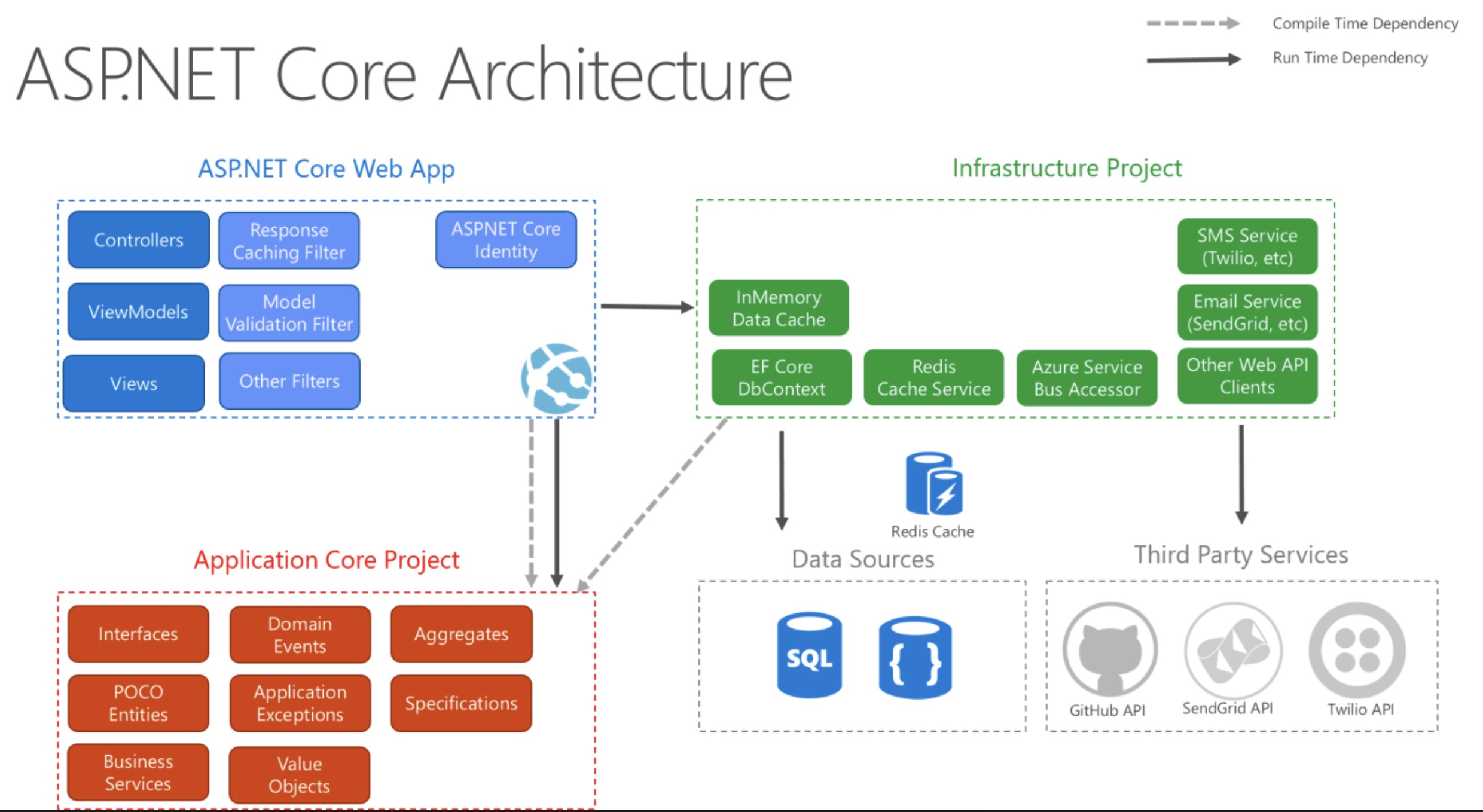
28.1 The Three Projects Structure
ASP.NET Core Clean Architecture typically uses three separate projects (not just folders!):
Solution: CTStrokeAI.sln
│
├── CTStrokeAI.Core/           ← Application Core Project (Red)
├── CTStrokeAI.Infrastructure/ ← Infrastructure Project (Green)
└── CTStrokeAI.Web/            ← ASP.NET Core Web App (Blue)
28.2 Project 1: Application Core (Red) 🔴
28.2.1 What’s Inside
From your first screenshot, the Application Core contains:
CTStrokeAI.Core/
├── Entities/
│   ├── Patient.cs
│   ├── CTScan.cs
│   └── StrokeResult.cs
├── Interfaces/
│   ├── IScanRepository.cs
│   ├── IStrokeDetector.cs
│   └── INotificationService.cs
├── Services/ (Domain Services)
│   ├── AspectsCalculator.cs
│   └── ClinicalAdvisor.cs
├── Aggregates/
│   └── StrokeAssessmentAggregate.cs
├── ValueObjects/
│   ├── AspectsScore.cs
│   └── PatientAge.cs
├── Specifications/
│   └── StrokeEligibilitySpec.cs
├── DomainEvents/
│   └── StrokeDiagnosedEvent.cs
└── Exceptions/
    └── InvalidAspectsScoreException.cs
28.2.2 Key Characteristics
✅ Contains:
   • Pure business logic
   • Domain entities
   • Business rules
   • Interface definitions

❌ Does NOT contain:
   • Database code
   • HTTP requests
   • File I/O
   • External service calls
   • ANY infrastructure

Dependencies: NONE (or minimal like System.Collections)
28.2.3 Example Code: Entity (POCO - Plain Old CLR Object)
// Core/Entities/Patient.cs
namespace CTStrokeAI.Core.Entities
{
    public class Patient
    {
        public int Id { get; private set; }
        public string HospitalNumber { get; private set; }
        public string Name { get; private set; }
        public DateTime DateOfBirth { get; private set; }

        // Pure business logic - no database concerns
        public int GetAge()
        {
            var today = DateTime.Today;
            var age = today.Year - DateOfBirth.Year;
            if (DateOfBirth.Date > today.AddYears(-age)) age--;
            return age;
        }

        // Domain rule
        public bool IsEligibleForThrombolysis()
        {
            int age = GetAge();
            return age >= 18 && age <= 80;  // Business rule
        }
    }
}
28.2.4 Example Code: Interface
// Core/Interfaces/IScanRepository.cs
namespace CTStrokeAI.Core.Interfaces
{
    public interface IScanRepository
    {
        Task<CTScan> GetByIdAsync(int scanId);
        Task<List<CTScan>> GetByPatientAsync(int patientId);
        Task<CTScan> AddAsync(CTScan scan);
        Task UpdateAsync(CTScan scan);
        Task DeleteAsync(int scanId);
    }

    // Core defines WHAT it needs, not HOW it's implemented
}
28.2.5 Example Code: Domain Service
// Core/Services/AspectsCalculator.cs
namespace CTStrokeAI.Core.Services
{
    public class AspectsCalculator
    {
        // Pure business logic
        public int CalculateScore(CTScan scan)
        {
            int score = 10; // Start with 10 points

            // Business rules for ASPECTS scoring
            if (HasInfarct(scan.M1Region)) score--;
            if (HasInfarct(scan.M2Region)) score--;
            if (HasInfarct(scan.M3Region)) score--;
            // ... more regions

            return score;
        }

        public string GetRecommendation(int aspectsScore)
        {
            // Clinical decision rules
            return aspectsScore switch
            {
                >= 8 => "Good candidate for thrombolysis",
                >= 6 => "Discuss with stroke team",
                _ => "Large infarct - thrombolysis not recommended"
            };
        }

        private bool HasInfarct(RegionData region)
        {
            // Domain logic
            return region.Hypodensity > 0.5;
        }
    }
}
28.3 Project 2: Infrastructure (Green) 🟢
28.3.1 What’s Inside
From your first screenshot, Infrastructure contains the implementations:
CTStrokeAI.Infrastructure/
├── Data/
│   ├── EfCoreDbContext.cs       ← Entity Framework
│   └── Repositories/
│       ├── EfScanRepository.cs  ← Implements IScanRepository
│       └── CacheScanRepository.cs
├── Services/
│   ├── SmsService.cs            ← Implements INotificationService
│   ├── EmailService.cs
│   └── RedisCacheService.cs
├── ExternalApis/
│   ├── PacsConnector.cs
│   ├── AzureServiceBusAccessor.cs
│   └── GithubApiClient.cs
└── InMemoryCache/
    └── MemoryCacheAdapter.cs
28.3.2 Key Characteristics
✅ Contains:
   • Database implementations (EF Core)
   • External API clients
   • File system operations
   • Cache implementations
   • Email/SMS services
   • Implements interfaces from Core

Dependencies:
   • Application Core (implements its interfaces)
   • External packages (EF Core, Redis, etc.)
28.3.3 Example Code: Repository Implementation
// Infrastructure/Data/Repositories/EfScanRepository.cs
using CTStrokeAI.Core.Entities;
using CTStrokeAI.Core.Interfaces;
using Microsoft.EntityFrameworkCore;

namespace CTStrokeAI.Infrastructure.Data.Repositories
{
    public class EfScanRepository : IScanRepository
    {
        private readonly AppDbContext _dbContext;

        public EfScanRepository(AppDbContext dbContext)
        {
            _dbContext = dbContext;
        }

        public async Task<CTScan> GetByIdAsync(int scanId)
        {
            // Entity Framework implementation
            return await _dbContext.CTScans
                .Include(s => s.Patient)
                .FirstOrDefaultAsync(s => s.Id == scanId);
        }

        public async Task<List<CTScan>> GetByPatientAsync(int patientId)
        {
            return await _dbContext.CTScans
                .Where(s => s.PatientId == patientId)
                .OrderByDescending(s => s.AcquisitionDate)
                .ToListAsync();
        }

        public async Task<CTScan> AddAsync(CTScan scan)
        {
            await _dbContext.CTScans.AddAsync(scan);
            await _dbContext.SaveChangesAsync();
            return scan;
        }

        // ... other methods
    }
}
28.3.4 Example Code: External Service Implementation
// Infrastructure/Services/EmailService.cs
using CTStrokeAI.Core.Interfaces;
using SendGrid;
using SendGrid.Helpers.Mail;

namespace CTStrokeAI.Infrastructure.Services
{
    public class EmailService : INotificationService
    {
        private readonly SendGridClient _client;
        private readonly string _fromEmail;

        public EmailService(string apiKey, string fromEmail)
        {
            _client = new SendGridClient(apiKey);
            _fromEmail = fromEmail;
        }

        public async Task NotifyAsync(string recipient, string message)
        {
            var from = new EmailAddress(_fromEmail);
            var to = new EmailAddress(recipient);
            var msg = MailHelper.CreateSingleEmail(from, to,
                "Stroke Detection Alert", message, message);

            await _client.SendEmailAsync(msg);
        }
    }
}
28.3.5 Example Code: DbContext
// Infrastructure/Data/AppDbContext.cs
using Microsoft.EntityFrameworkCore;
using CTStrokeAI.Core.Entities;

namespace CTStrokeAI.Infrastructure.Data
{
    public class AppDbContext : DbContext
    {
        public AppDbContext(DbContextOptions<AppDbContext> options)
            : base(options)
        {
        }

        public DbSet<Patient> Patients { get; set; }
        public DbSet<CTScan> CTScans { get; set; }
        public DbSet<StrokeResult> StrokeResults { get; set; }

        protected override void OnModelCreating(ModelBuilder modelBuilder)
        {
            // EF Core configuration
            modelBuilder.Entity<Patient>()
                .HasMany(p => p.Scans)
                .WithOne(s => s.Patient)
                .HasForeignKey(s => s.PatientId);
        }
    }
}
28.4 Project 3: ASP.NET Core Web App (Blue) 🔵
28.4.1 What’s Inside
From your first screenshot, the Web App contains:
CTStrokeAI.Web/
├── Controllers/
│   ├── StrokeDetectionController.cs
│   └── PatientController.cs
├── ViewModels/
│   ├── StrokeResultViewModel.cs
│   └── PatientViewModel.cs
├── Views/
│   ├── Home/
│   └── Stroke/
├── Filters/
│   ├── ResponseCachingFilter.cs
│   └── ModelValidationFilter.cs
├── Program.cs              ← Entry point
├── Startup.cs              ← DI configuration
└── appsettings.json
28.4.2 Key Characteristics
✅ Contains:
   • MVC Controllers
   • Razor Views
   • ViewModels (DTOs)
   • Filters/Middleware
   • Dependency injection setup
   • HTTP concerns

Dependencies:
   • Application Core
   • Infrastructure (at startup only)
28.4.3 Example Code: Controller
// Web/Controllers/StrokeDetectionController.cs
using Microsoft.AspNetCore.Mvc;
using CTStrokeAI.Core.Interfaces;
using CTStrokeAI.Core.Services;

namespace CTStrokeAI.Web.Controllers
{
    [ApiController]
    [Route("api/[controller]")]
    public class StrokeDetectionController : ControllerBase
    {
        private readonly IScanRepository _scanRepo;
        private readonly AspectsCalculator _calculator;
        private readonly INotificationService _notifier;

        public StrokeDetectionController(
            IScanRepository scanRepo,
            AspectsCalculator calculator,
            INotificationService notifier)
        {
            _scanRepo = scanRepo;
            _calculator = calculator;
            _notifier = notifier;
        }

        [HttpPost("analyze/{scanId}")]
        public async Task<IActionResult> AnalyzeScan(int scanId)
        {
            // Get scan using interface (don't care about implementation!)
            var scan = await _scanRepo.GetByIdAsync(scanId);

            if (scan == null)
                return NotFound();

            // Use business logic from Core
            int aspectsScore = _calculator.CalculateScore(scan);
            string recommendation = _calculator.GetRecommendation(aspectsScore);

            // Notify using interface
            if (aspectsScore <= 5)
            {
                await _notifier.NotifyAsync(
                    "stroke-team@ramathibodi.go.th",
                    $"Critical: Low ASPECTS score ({aspectsScore}) for scan {scanId}"
                );
            }

            // Return ViewModel
            return Ok(new StrokeResultViewModel
            {
                ScanId = scanId,
                AspectsScore = aspectsScore,
                Recommendation = recommendation
            });
        }
    }
}
28.4.4 Example Code: Dependency Injection Setup
// Web/Program.cs (ASP.NET Core 6+)
using CTStrokeAI.Core.Interfaces;
using CTStrokeAI.Core.Services;
using CTStrokeAI.Infrastructure.Data;
using CTStrokeAI.Infrastructure.Data.Repositories;
using CTStrokeAI.Infrastructure.Services;
using Microsoft.EntityFrameworkCore;

var builder = WebApplication.CreateBuilder(args);

// Add services to the container
builder.Services.AddControllers();

// Database
builder.Services.AddDbContext<AppDbContext>(options =>
    options.UseSqlServer(
        builder.Configuration.GetConnectionString("DefaultConnection")
    ));

// Register Core services
builder.Services.AddScoped<AspectsCalculator>();

// Register Infrastructure implementations
builder.Services.AddScoped<IScanRepository, EfScanRepository>();
builder.Services.AddScoped<INotificationService, EmailService>(sp =>
    new EmailService(
        builder.Configuration["SendGrid:ApiKey"],
        builder.Configuration["SendGrid:FromEmail"]
    ));

// Add caching
builder.Services.AddMemoryCache();
builder.Services.AddScoped<INotificationService, SmsService>();

var app = builder.Build();

// Configure the HTTP request pipeline
app.UseRouting();
app.MapControllers();

app.Run();
28.5 Dependency Flow Visualization
28.5.1 Compile-Time Dependencies
┌─────────────────────────────────────────────────┐
│         ASP.NET Core Web App (Blue)             │
│                                                 │
│  Controllers, Views, Filters                    │
└─────────────┬────────────────┬──────────────────┘
              │                │
              │ references     │ references
              │                │ (startup only)
              ▼                ▼
┌─────────────────────┐  ┌────────────────────────┐
│ Application Core    │  │  Infrastructure        │
│     (Red)           │  │     (Green)            │
│                     │  │                        │
│ • Entities          │  │ • EF Core DbContext    │
│ • Interfaces        │◄─┤ • Repositories (impl)  │
│ • Domain Services   │  │ • External APIs        │
└─────────────────────┘  │ • Email/SMS Services   │
         ▲               └────────────────────────┘
         │                         │
         │ NO dependency!          │ uses
         │                         ▼
         │               ┌─────────────────────┐
         │               │ External Resources  │
         │               │ • SQL Database      │
         └───────────────┤ • Redis Cache       │
                         │ • SendGrid API      │
                         └─────────────────────┘

Key: Infrastructure depends on Core
     Core depends on NOTHING
     Web depends on both (but uses Core interfaces)
28.5.2 Runtime Dependencies (via Dependency Injection)
HTTP Request arrives
       │
       ▼
┌─────────────────┐
│   Controller    │
│                 │
│  Needs:         │
│  • IScanRepo    │◄──┐
│  • INotifier    │◄──┤  DI Container injects
└─────────────────┘   │  concrete implementations
                      │
                      │
        ┌─────────────┴─────────────┐
        │                           │
┌───────▼────────┐         ┌────────▼──────────┐
│ EfScanRepo     │         │  EmailService     │
│ (from Infra)   │         │  (from Infra)     │
└────────────────┘         └───────────────────┘

Controller only knows about interfaces!
DI provides the implementations at runtime
28.6 Testing Strategy
28.6.1 Unit Tests (Figure 5-10) - Test Application Core
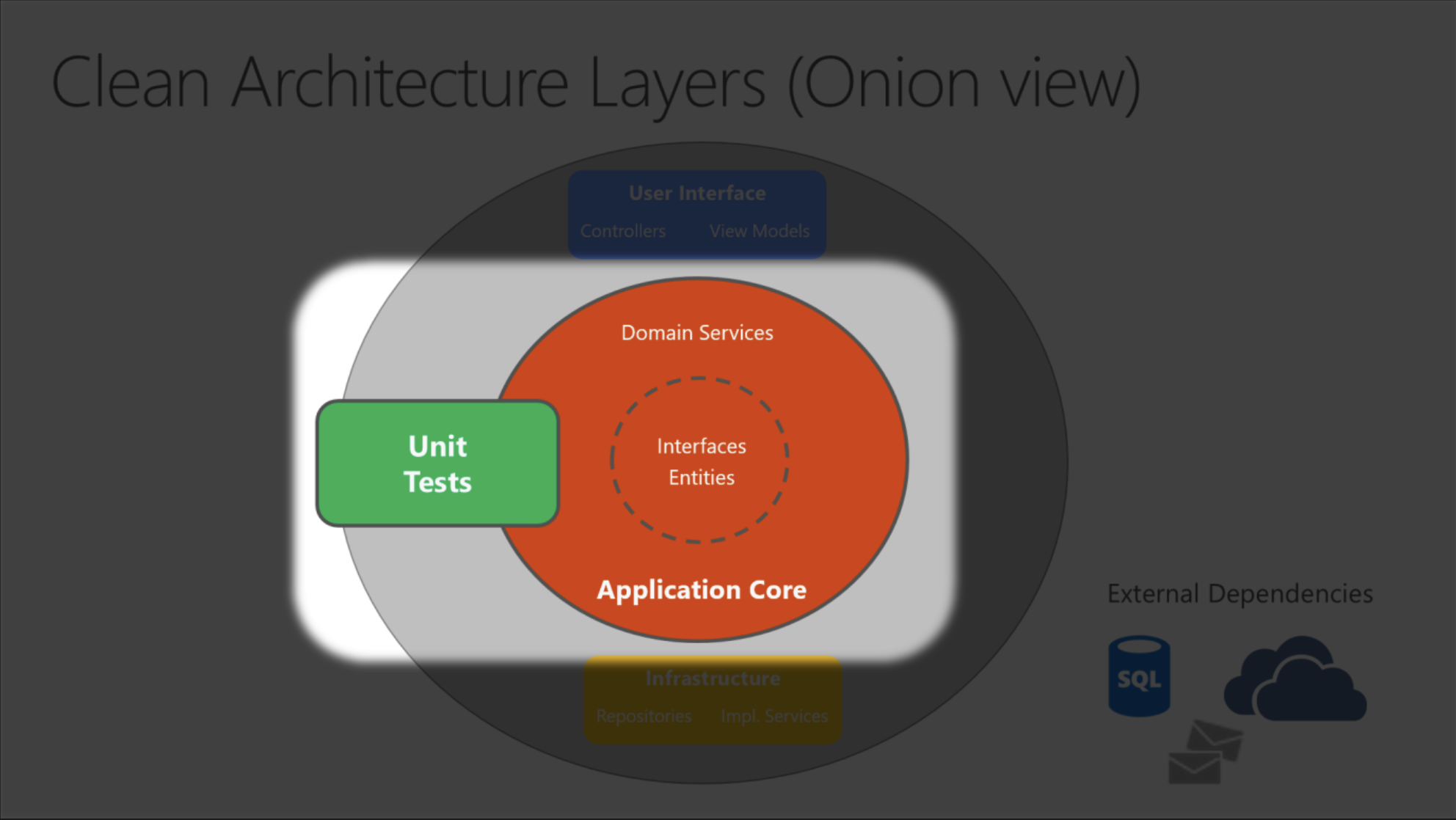
From your second screenshot, Unit Tests target Application Core in isolation:
┌─────────────────────────────────────────────┐
│              Unit Test Project              │
│                  (Green)                    │
│                                             │
│  Tests pure business logic with NO external │
│  dependencies                               │
└──────────────────┬──────────────────────────┘
                   │
                   │ tests
                   ▼
┌─────────────────────────────────────────────┐
│          Application Core (Red)             │
│                                             │
│  ┌───────────────────────────┐              │
│  │   Entities + Interfaces   │              │
│  │   Domain Services         │              │
│  └───────────────────────────┘              │
└─────────────────────────────────────────────┘

NO Database, NO APIs, NO External Services!
Fast, isolated, reliable tests
Example - Unit Test:
// Tests/Core/Services/AspectsCalculatorTests.cs
using Xunit;
using CTStrokeAI.Core.Services;
using CTStrokeAI.Core.Entities;

namespace CTStrokeAI.Tests.Core.Services
{
    public class AspectsCalculatorTests
    {
        [Fact]
        public void CalculateScore_NoInfarcts_ReturnsFullScore()
        {
            // Arrange
            var calculator = new AspectsCalculator();
            var scan = new CTScan
            {
                M1Region = new RegionData { Hypodensity = 0.1 },
                M2Region = new RegionData { Hypodensity = 0.1 },
                M3Region = new RegionData { Hypodensity = 0.1 }
                // All regions normal
            };

            // Act
            int score = calculator.CalculateScore(scan);

            // Assert
            Assert.Equal(10, score);
        }

        [Fact]
        public void GetRecommendation_HighScore_RecommendsThrombolysis()
        {
            // Arrange
            var calculator = new AspectsCalculator();

            // Act
            string recommendation = calculator.GetRecommendation(9);

            // Assert
            Assert.Contains("thrombolysis", recommendation.ToLower());
        }

        [Theory]
        [InlineData(10, "Good candidate")]
        [InlineData(8, "Good candidate")]
        [InlineData(7, "Discuss with stroke team")]
        [InlineData(5, "not recommended")]
        public void GetRecommendation_VariousScores_ReturnsExpected(
            int score, string expectedText)
        {
            // Arrange
            var calculator = new AspectsCalculator();

            // Act
            string recommendation = calculator.GetRecommendation(score);

            // Assert
            Assert.Contains(expectedText, recommendation);
        }
    }
}
Unit Test with Mock (Test with Interface):
// Tests/Core/Services/PatientServiceTests.cs
using Xunit;
using Moq;
using CTStrokeAI.Core.Interfaces;
using CTStrokeAI.Core.Services;
using CTStrokeAI.Core.Entities;

namespace CTStrokeAI.Tests.Core.Services
{
    public class PatientServiceTests
    {
        [Fact]
        public async Task ProcessStrokeScan_CriticalCase_SendsNotification()
        {
            // Arrange
            var mockNotifier = new Mock<INotificationService>();
            var mockRepo = new Mock<IScanRepository>();

            var scan = new CTScan { Id = 1, PatientId = 100 };
            mockRepo.Setup(r => r.GetByIdAsync(1))
                .ReturnsAsync(scan);

            var calculator = new AspectsCalculator();
            var service = new StrokeAnalysisService(
                mockRepo.Object,
                calculator,
                mockNotifier.Object
            );

            // Act
            await service.AnalyzeScanAsync(1);

            // Assert
            mockNotifier.Verify(
                n => n.NotifyAsync(
                    It.IsAny<string>(),
                    It.IsAny<string>()),
                Times.Once
            );
        }
    }
}
Benefits of Unit Tests:
✅ FAST: No database, no network, no I/O
✅ ISOLATED: Test business logic alone
✅ RELIABLE: No external dependencies = no flaky tests
✅ EASY TO WRITE: Simple setup, no infrastructure

Test Speed:
Unit Tests: ~1-10 ms per test
Integration Tests: ~100-1000 ms per test
28.6.2 Integration Tests (Figure 5-11) - Test Infrastructure
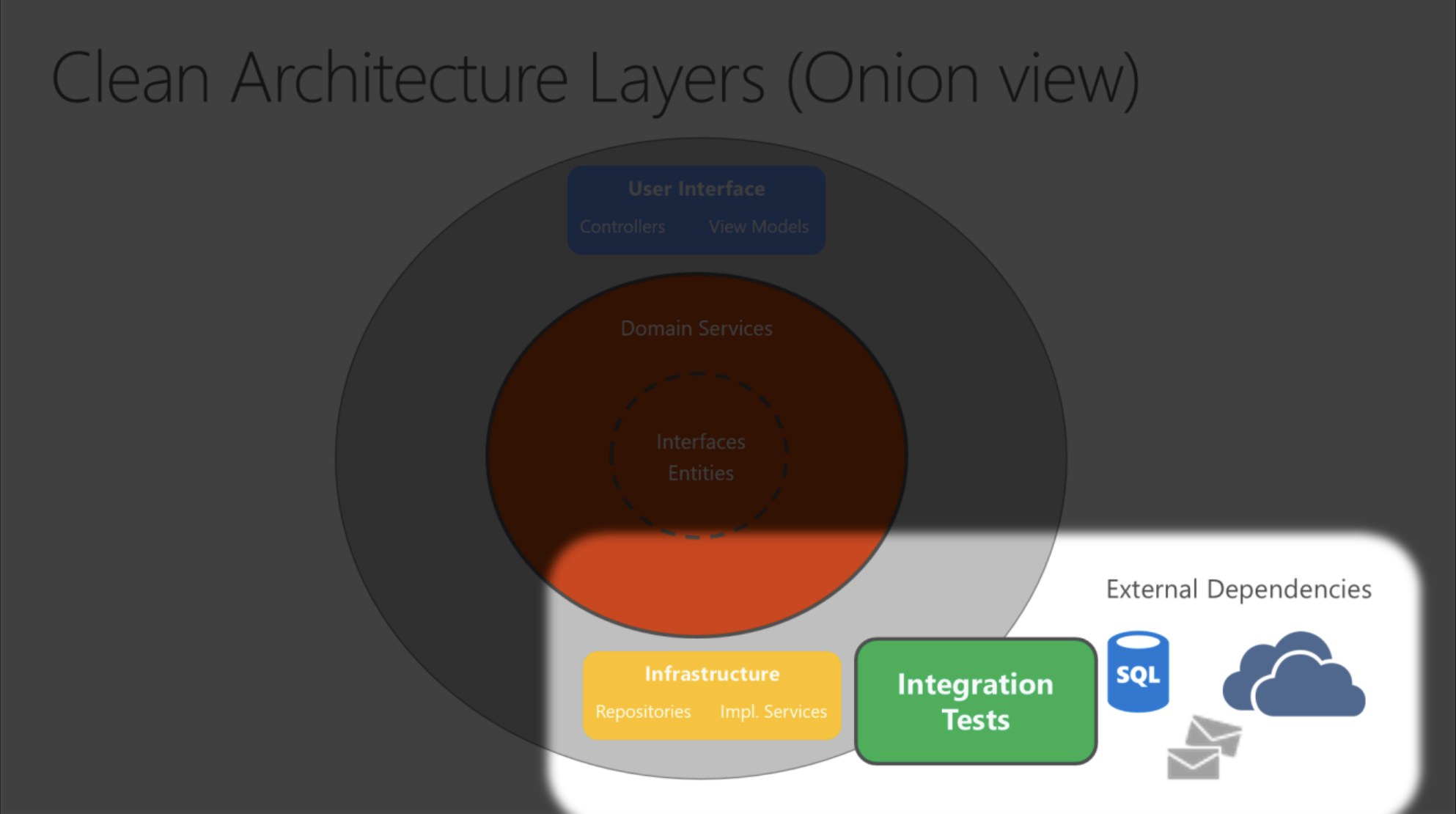
From your third screenshot, Integration Tests target Infrastructure with real dependencies:
┌──────────────────────────────────────────────┐
│         Integration Test Project             │
│              (Green)                         │
│                                              │
│  Tests infrastructure implementations with   │
│  REAL external dependencies                  │
└──────────────┬───────────────────────────────┘
               │
               │ tests
               ▼
┌──────────────────────────────────────────────┐
│        Infrastructure (Yellow)               │
│                                              │
│  • Repositories                              │
│  • External API clients                      │
└────────────────┬─────────────────────────────┘
                 │
                 │ connects to
                 ▼
┌──────────────────────────────────────────────┐
│       External Dependencies                  │
│  • SQL Database (test DB)                    │
│  • Cloud Storage                             │
│  • Email service                             │
└──────────────────────────────────────────────┘

Uses REAL infrastructure
Tests actual implementations
Example - Integration Test:
// Tests/Infrastructure/Data/EfScanRepositoryTests.cs
using Xunit;
using Microsoft.EntityFrameworkCore;
using CTStrokeAI.Infrastructure.Data;
using CTStrokeAI.Infrastructure.Data.Repositories;
using CTStrokeAI.Core.Entities;

namespace CTStrokeAI.Tests.Infrastructure.Data
{
    public class EfScanRepositoryTests : IDisposable
    {
        private readonly AppDbContext _context;
        private readonly EfScanRepository _repository;

        public EfScanRepositoryTests()
        {
            // Use in-memory database for testing
            var options = new DbContextOptionsBuilder<AppDbContext>()
                .UseInMemoryDatabase(databaseName: Guid.NewGuid().ToString())
                .Options;

            _context = new AppDbContext(options);
            _repository = new EfScanRepository(_context);
        }

        [Fact]
        public async Task AddAsync_ValidScan_SavesToDatabase()
        {
            // Arrange
            var patient = new Patient { HospitalNumber = "HN001" };
            var scan = new CTScan
            {
                Patient = patient,
                AcquisitionDate = DateTime.Now,
                Modality = "CT"
            };

            // Act
            var result = await _repository.AddAsync(scan);

            // Assert
            Assert.NotEqual(0, result.Id); // ID was assigned
            var savedScan = await _repository.GetByIdAsync(result.Id);
            Assert.NotNull(savedScan);
            Assert.Equal("CT", savedScan.Modality);
        }

        [Fact]
        public async Task GetByPatientAsync_MultipleScans_ReturnsAllScans()
        {
            // Arrange
            var patient = new Patient { HospitalNumber = "HN002" };
            await _context.Patients.AddAsync(patient);
            await _context.SaveChangesAsync();

            await _repository.AddAsync(new CTScan
            {
                PatientId = patient.Id,
                AcquisitionDate = DateTime.Now.AddDays(-2)
            });
            await _repository.AddAsync(new CTScan
            {
                PatientId = patient.Id,
                AcquisitionDate = DateTime.Now.AddDays(-1)
            });

            // Act
            var scans = await _repository.GetByPatientAsync(patient.Id);

            // Assert
            Assert.Equal(2, scans.Count);
            Assert.True(scans[0].AcquisitionDate > scans[1].AcquisitionDate);
            // Should be ordered by date descending
        }

        public void Dispose()
        {
            _context.Dispose();
        }
    }
}
Integration Test with Real Database:
// Tests/Infrastructure/ExternalApis/PacsConnectorTests.cs
using Xunit;
using CTStrokeAI.Infrastructure.ExternalApis;

namespace CTStrokeAI.Tests.Infrastructure.ExternalApis
{
    // These tests require a real test PACS server
    [Collection("PACS Tests")]
    public class PacsConnectorTests
    {
        private readonly string _testPacsHost = "test-pacs.ramathibodi.local";
        private readonly int _testPacsPort = 11112;

        [Fact]
        public async Task QueryStudy_ValidStudyId_ReturnsData()
        {
            // Arrange
            var connector = new PacsConnector(_testPacsHost, _testPacsPort);
            string testStudyId = "1.2.840.113619.2.55.3.test";

            // Act
            var study = await connector.QueryStudyAsync(testStudyId);

            // Assert
            Assert.NotNull(study);
            Assert.Equal(testStudyId, study.StudyInstanceUID);
        }

        [Fact]
        public async Task RetrieveSeries_ExistingSeries_DownloadsImages()
        {
            // Arrange
            var connector = new PacsConnector(_testPacsHost, _testPacsPort);

            // Act
            var images = await connector.RetrieveSeriesAsync(
                "1.2.840.test.series"
            );

            // Assert
            Assert.NotEmpty(images);
            Assert.True(images.Count > 0);
        }
    }
}
28.7 Complete Radiology AI Example
28.7.1 Project Structure
CTStrokeAI.sln
│
├── src/
│   ├── CTStrokeAI.Core/              ← Application Core
│   │   ├── Entities/
│   │   │   ├── Patient.cs
│   │   │   ├── CTScan.cs
│   │   │   └── StrokeResult.cs
│   │   ├── Interfaces/
│   │   │   ├── IScanRepository.cs
│   │   │   ├── IModelService.cs
│   │   │   └── INotificationService.cs
│   │   └── Services/
│   │       ├── AspectsCalculator.cs
│   │       └── StrokeAnalysisService.cs
│   │
│   ├── CTStrokeAI.Infrastructure/    ← Infrastructure
│   │   ├── Data/
│   │   │   ├── AppDbContext.cs
│   │   │   └── Repositories/
│   │   │       └── EfScanRepository.cs
│   │   ├── Services/
│   │   │   ├── TensorFlowModelService.cs
│   │   │   └── SendGridEmailService.cs
│   │   └── ExternalApis/
│   │       └── PacsConnector.cs
│   │
│   └── CTStrokeAI.Web/               ← ASP.NET Core Web
│       ├── Controllers/
│       │   └── StrokeController.cs
│       ├── ViewModels/
│       │   └── StrokeResultViewModel.cs
│       ├── Program.cs
│       └── appsettings.json
│
└── tests/
    ├── CTStrokeAI.UnitTests/         ← Unit Tests
    │   └── Core/
    │       └── Services/
    │           └── AspectsCalculatorTests.cs
    │
    └── CTStrokeAI.IntegrationTests/  ← Integration Tests
        └── Infrastructure/
            └── Data/
                └── EfScanRepositoryTests.cs
28.7.2 Dependency Graph
┌───────────────────────────────────────────────────────┐
│                  CTStrokeAI.Web                       │
│                                                       │
│  Program.cs ─┐                                        │
│              │  configures DI                         │
└──────────────┼────────────────────────────────────────┘
               │
       ┌───────┴────────┬─────────────────┐
       │                │                 │
       ▼                ▼                 │
┌─────────────┐  ┌────────────────┐       │
│  Core       │  │ Infrastructure │       │
│  (Pure)     │◄─┤ (Implements)   │       │
└─────────────┘  └────────┬───────┘       │
                          │               │
                          ▼               │
                 ┌────────────────┐       │
                 │  EF Core       │       │
                 │  SendGrid      │       │
                 │  pydicom       │       │
                 └────────────────┘       │
                                          │
       ┌──────────────────────────────────┘
       │
       ▼
┌────────────────┐
│  Unit Tests    │  (test Core)
└────────────────┘

┌────────────────┐
│  Integration   │  (test Infrastructure)
│  Tests         │
└────────────────┘
28.8 Key Benefits of This Architecture
28.8.1 1. Testability
Unit Tests:
✅ Test business logic in isolation
✅ Fast (milliseconds)
✅ No external dependencies
✅ Run on every commit

Integration Tests:
✅ Test infrastructure with real systems
✅ Catch integration issues
✅ Confidence before deployment
28.8.2 2. Flexibility
Switch Database:
SQL Server → PostgreSQL
Just change Infrastructure project
Core remains unchanged!

Switch Notification:
Email → SMS → Slack
Just change Infrastructure project
Core remains unchanged!
28.8.3 3. Maintainability
Clear separation:
• Core = Business rules (rarely changes)
• Infrastructure = Tech details (changes often)
• Web = UI/API (changes frequently)

Each team can work independently
28.8.4 4. Framework Independence
Application Core has NO dependency on:
❌ ASP.NET Core
❌ Entity Framework
❌ Any external library

Can move to:
✅ Different web framework (Blazor, gRPC)
✅ Different ORM (Dapper, NPoco)
✅ Different platform (Azure Functions, AWS Lambda)
28.9 Summary
ASP.NET Core Clean Architecture uses three projects:
┌─────────────────────────────────────────┐
│  Web (Blue) - ASP.NET Core              │
│  • Controllers, Views, Filters          │
│  • Coordinates requests                 │
└───────┬─────────────────────────────────┘
        │ depends on both
    ┌───┴────┬────────────────────┐
    ▼        ▼                    │
┌────────┐  ┌──────────────────┐  │
│ Core   │  │ Infrastructure   │  │
│ (Red)  │◄─┤ (Green)          │  │
│        │  │                  │  │
│ Pure   │  │ Implements       │  │
│ Logic  │  │ interfaces       │  │
└────────┘  └──────┬───────────┘  │
                   │              │
                   ▼              │
            ┌──────────────┐      │
            │  External    │      │
            │  Systems     │      │
            └──────────────┘      │
                                  │
            ┌──────────────────┐  │
            │  Unit Tests      │──┘
            │  (Green)         │
            └──────────────────┘

            ┌──────────────────┐
            │  Integration     │
            │  Tests (Green)   │
            └──────────────────┘
Three key principles:
- Dependency Inversion: Infrastructure → Core (not Core → Infrastructure)
- Interface Segregation: Core defines interfaces, Infrastructure implements
- Separation of Concerns: Each project has ONE responsibility